Safaricom Hits Ksh 414B Revenue in FY2026
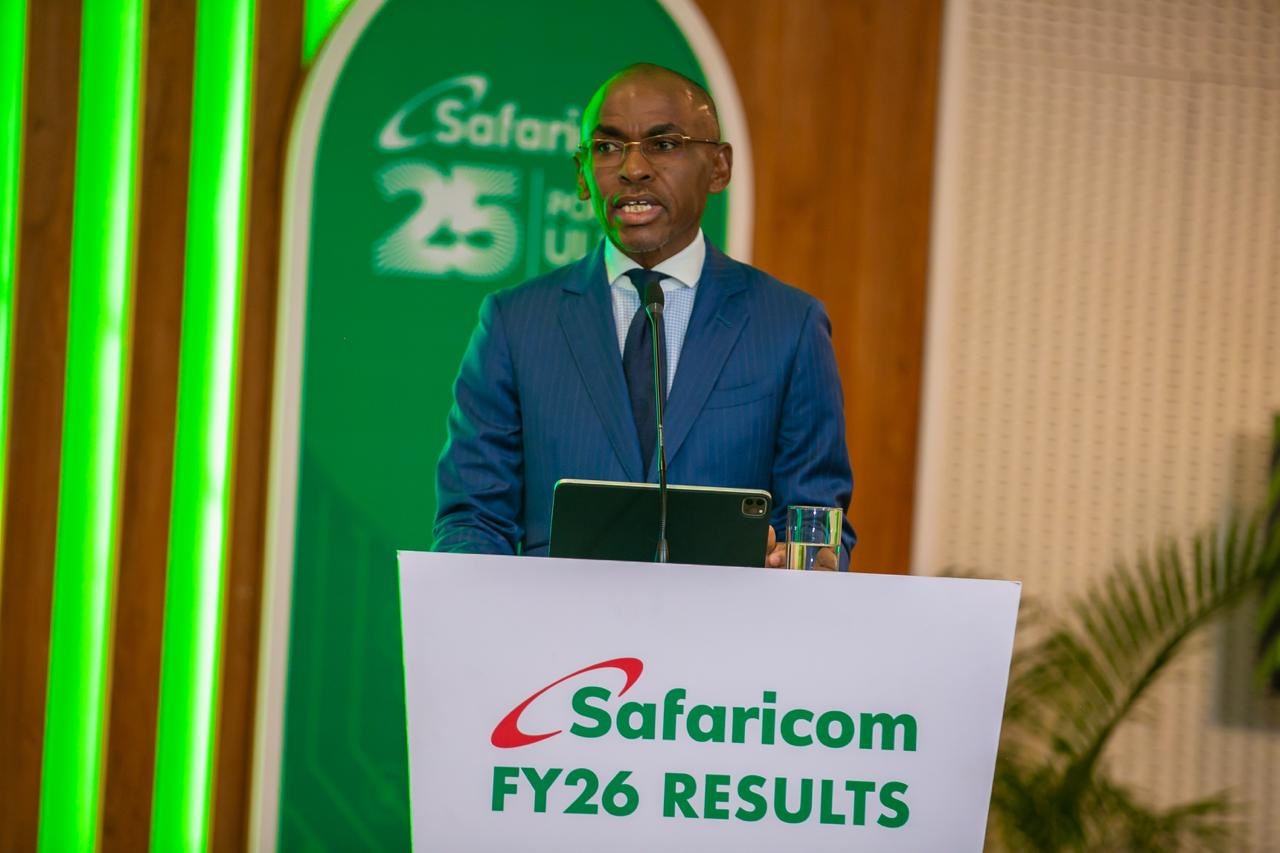
Safaricom Crosses KSh 400 Billion Revenue Mark as Profit Jumps and Ethiopia Losses Narrow
Safaricom has delivered one of the strongest financial performances in its history, crossing the Ksh 400 billion mark in service revenue while posting Ksh 100 billion in net income for the financial year ended March 2026.
The telco announced a total dividend payout of Ksh 80.1 billion, equivalent to Ksh 2.00 per share, marking a 66.7% increase from the previous financial year. The payout includes an interim dividend of Ksh 0.85 and a final dividend of Ksh 1.15 per share.
Group service revenue rose to Ksh 414 billion as Safaricom continued to lean on M-PESA, mobile data, enterprise services, and growing momentum in Ethiopia.
The results land at a time when Safaricom is trying to balance three things at once: defending its dominance in Kenya, scaling operations in Ethiopia and positioning itself as a broader technology company beyond telecoms.
Ethiopia Is Finally Starting to Shift the Story
For the last few years, Ethiopia has largely been discussed as Safaricom’s expensive expansion bet.
That conversation is beginning to change.
The company says commercial momentum in Ethiopia is improving, helped by pricing adjustments, network expansion, and regulatory progress around infrastructure sharing and interconnection.
Speaking during the results announcement, Safaricom Chairman Adil Khawaja said the Ethiopian business is now moving “from rollout to scale.”
“With network coverage now exceeding 50% and strong customer growth, Ethiopia is moving from rollout to scale,” he said.
The market is still in investment phase and continues to weigh on costs, but losses narrowed significantly during the year as the operation gained scale. Reuters previously reported that Safaricom expected negative EBIT in Ethiopia to improve sharply compared to earlier years.
That matters because Ethiopia remains central to Safaricom’s long-term regional ambitions.

M-PESA and Data Continue to Carry the Business
Back home, M-PESA and mobile data remained Safaricom’s biggest growth engines.
M-PESA revenue in Kenya grew 13.4% to Ksh 182.7 billion, continuing its position as the company’s most important financial services product.
Mobile data usage also continued to rise as more customers shifted to streaming, digital payments, remote work and smartphone-based services.
Safaricom now says it serves 72 million customers across its markets.
Chairman Adil Khawaja used the results presentation to push a wider message around impact and scale.
“From the mzee in Kakamega receiving social support through M-PESA, to communities in Wajir accessing 4G connectivity for the first time, to young Kenyans benefiting from our Citizens of the Future programme, this is the real measure of Safaricom,” he said.
The company also disclosed that its foundations and social programmes touched 4.4 million lives during the financial year.
Safaricom’s 25-Year Licence Changes the Long-Term Picture
One of the biggest developments around the business this year did not come from earnings.
Safaricom secured a new unified licence from the Communications Authority of Kenya that allows it to operate for another 25 years in Kenya.
For investors, that removes a major layer of uncertainty around the company’s long-term operations.
Khawaja described the licence renewal as “more than a regulatory milestone,” saying it gives Safaricom the confidence to continue investing in infrastructure, digital services and financial technology.
The company also welcomed the rollout of the KESONIA risk-based pricing framework by the Central Bank of Kenya, which Safaricom believes aligns well with its digital lending and fintech operations.
A Bigger Technology Play
Safaricom has spent the last few years trying to redefine itself beyond being viewed strictly as a telecom operator.
Vision 2030, the company’s current strategic plan, aims to position Safaricom as Africa’s leading purpose-led technology company.
That ambition stretches across connectivity, financial services, enterprise technology, digital infrastructure and regional expansion.
Competition, however, is becoming sharper, especially in fintech and digital services.
Khawaja acknowledged the pressure during his remarks, saying Safaricom’s strategy remains focused on protecting its core business while continuing to innovate around new products and services.
For now, the numbers suggest the company still has room to grow.
Crossing KSh 400 billion in service revenue is a major milestone for a Kenyan company. Reaching KSh 100 billion in net income while still funding an aggressive expansion strategy in Ethiopia makes the result even more significant.