Equity posts KSh45.5bn half-year profit as James Mwangi says the bank’s transformation phase is complete
Equity opened the second half of 2026 with KSh45.5 billion in profit after tax, alongside double-digit growth in deposits, loans and shareholder returns that kept momentum building across the group.
During the investor presentation, management said the first-half performance landed almost exactly where it had projected in its 2026 guidance, strengthening its confidence that the bank remains on course to meet its full-year targets.
The numbers marked another strong half for the regional lender. Customer deposits reached KSh1.59 trillion, up 21% from the same period last year, while net loans grew to KSh981 billion, a 19% increase. Total assets climbed to KSh2.16 trillion, total income rose 25% to KSh124.9 billion, and profit before tax expanded 39% to KSh57.8 billion.
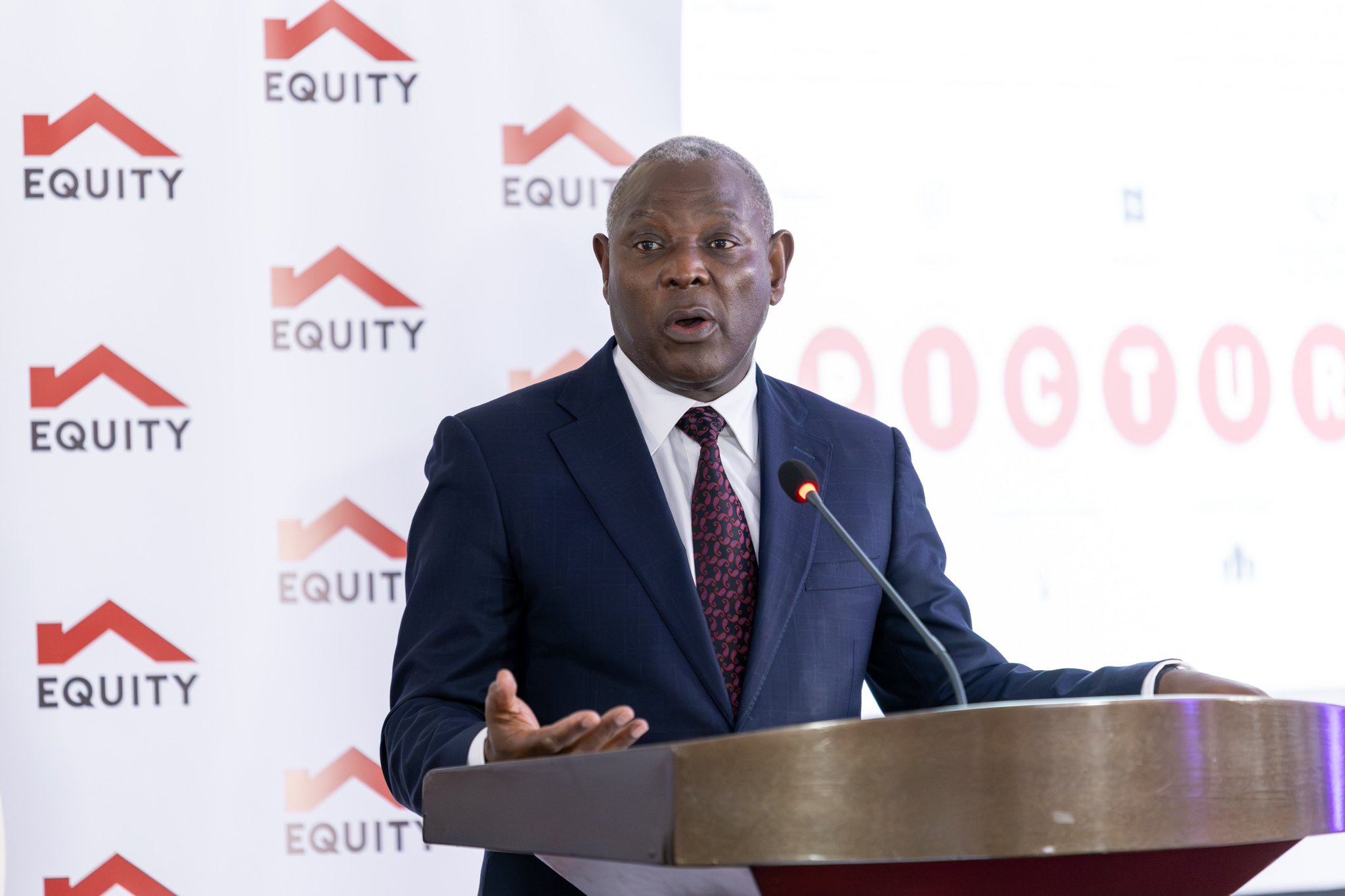
Chief Executive James Mwangi described the results as evidence that the group’s transformation programme has reached a point where management can forecast performance with confidence.
“We have met the guidance half year. We shall meet the guidance by the end of the year,” Mwangi said during the presentation.
Equity’s first-half numbers point to another record year
The headline figures showed broad-based growth across the business rather than a single standout area carrying performance.
Profit attributable to shareholders rose to KSh43.8 billion from KSh33.3 billion a year earlier, while earnings per share increased from KSh8.82 to KSh11.61, representing 32% growth.
The income statement showed that non-funded income remained an important contributor to earnings, growing 36% to KSh55.6 billion, while net interest income rose 17% to KSh69.3 billion despite lower interest expenses.
Revenue and profitability strengthened across the group
The bank’s profitability ratios also improved.
Return on equity reached 26.5%, while return on average assets climbed to 4.5%. Cost-to-income improved to 48.6%, down from 51.7%, reflecting better operating efficiency.
Management repeatedly returned to efficiency during the presentation, arguing that the bank’s operating model has become easier to manage after several years of investment across the group.
Quarterly performance illustrated that trend. Profit before tax rose from KSh24.5 billion in Q1 2026 to KSh33.3 billion in Q2 2026, while shareholder funds increased steadily to KSh350.3 billion by the end of June.
Asset quality also improved in several measures. The stock of non-performing loans fell from KSh124.7 billion in Q1 2025 to KSh99.7 billion in Q2 2026, although the group NPL ratio remained at 9.5%, above the upper end of management’s annual guidance.
Management says guidance remains on track
One of the presentation’s strongest themes was predictability rather than simply reporting higher profits.
The bank compared its H1 performance with its own guidance across several operating metrics.
Several growth measures exceeded guidance during the first half, particularly loans and deposits, while return on assets also finished above the annual target range. The cost-to-income ratio remained within management’s expected range.
Mwangi argued that accurately forecasting performance has become one of the group’s competitive strengths.
“The organisation is able to predict and whatever it promises it delivers,” he said, describing that consistency as part of the bank’s operating discipline.
Subsidiaries reached profitability faster than earlier markets
One of the presentation’s more revealing slides focused on how quickly newer subsidiaries have reached meaningful returns.
Equity highlighted the number of years required for different markets to exceed a 4% return on assets, using Kenya as the benchmark.
- Kenya reached the milestone after 16 years.
- Tanzania achieved it after 14 years.
- Rwanda reached it after 12 years.
Management argued that each new expansion has benefited from lessons learned in earlier markets, reducing the time required to build profitable operations.
Mwangi said the bank believes future markets could reach similar returns in roughly ten years as operating systems, business processes, capital allocation and management experience become more repeatable across countries.
The presentation also pointed to Uganda and the Democratic Republic of Congo as businesses approaching stronger profitability, with management saying higher returns from subsidiaries should translate into dividend contributions over time.
“The sacrifice that shareholders made during the transformation period… will be paid perpetually because the subsidiaries they funded are now joining in paying dividends.”
Equity compares itself with East Africa’s largest banks
The bank also placed its performance alongside other listed lenders in East Africa.
According to the market capitalisation comparison presented during the briefing, Equity’s market value stood at KSh301.9 billion as of 30 June 2026, ahead of Co-operative Bank at KSh201.2 billion and Absa at KSh174.1 billion, based on Business Daily market capitalisation data cited in the presentation.
The comparison extended beyond market value. Equity reported assets of KSh2.16 trillion, placing it among the region’s largest banking groups by balance sheet size while maintaining one of the strongest reported returns on equity in the peer group.
Management argued that investors should pay closer attention to how efficiently those assets generate earnings rather than balance sheet size alone.
Capital and liquidity remain well above growth needs
Another point that drew attention during the presentation was the group’s liquidity position.
Mwangi said 61% of the KSh2.16 trillion balance sheet is held in cash and liquid assets, describing that as evidence that the bank has substantial capacity to finance future expansion.
Capital ratios also remained comfortably above regulatory requirements, with management arguing that the balance sheet has ample room to support additional lending.
The presentation converted several headline figures into dollars to position Equity among larger sub-Saharan African financial institutions.
By management’s calculations, the group now operates with a $17 billion balance sheet, nearly $3 billion in shareholder funds, close to $1 billion in annualised revenue and roughly $450 million in pre-tax profit.
What shareholders are watching next
The presentation closed with management returning to the same point that framed much of the briefing: execution.
Rather than introducing new strategic announcements, Equity’s leadership argued that the transformation programme completed over recent years has produced a business whose performance can be forecast with greater confidence, whose subsidiaries are reaching profitability more quickly and whose capital position leaves room for further growth across the continent.
Whether the second half delivers the same pace of earnings growth remains to be seen, particularly with the NPL ratio still above management’s target range. Even so, the first-half results leave Equity entering the remainder of 2026 with stronger profitability, higher returns and a balance sheet that continues to expand across its regional footprint.