Why Integrated Appliances Are Winning Urban Kenya
Kenya’s changing skyline is also changing the way people think about their homes.
Across Nairobi and its growing satellite towns, apartments have become a practical choice for professionals, young families and people looking for homes closer to work and essential services. Rising land costs and continued urban growth are pushing development upwards, with more homes being designed around the reality of limited space.
That change is affecting something people may think about less often: the appliances inside those homes.
When every square metre has a purpose, a washing machine can no longer be considered in isolation. Homeowners are increasingly looking at how much space an appliance occupies, what it can do and whether several functions can be brought together without making the home feel cramped.
The laundry area is a good example.
When the laundry room gets smaller
In larger detached homes, finding room for a washing machine and separate dryer was often relatively straightforward.
Apartment living presents a different challenge.
Utility areas can be compact. Balconies may serve several purposes, while some newer developments have limited dedicated laundry space. For residents, finding room for two bulky appliances can therefore require some creativity.
This is where integrated appliances are gaining attention.
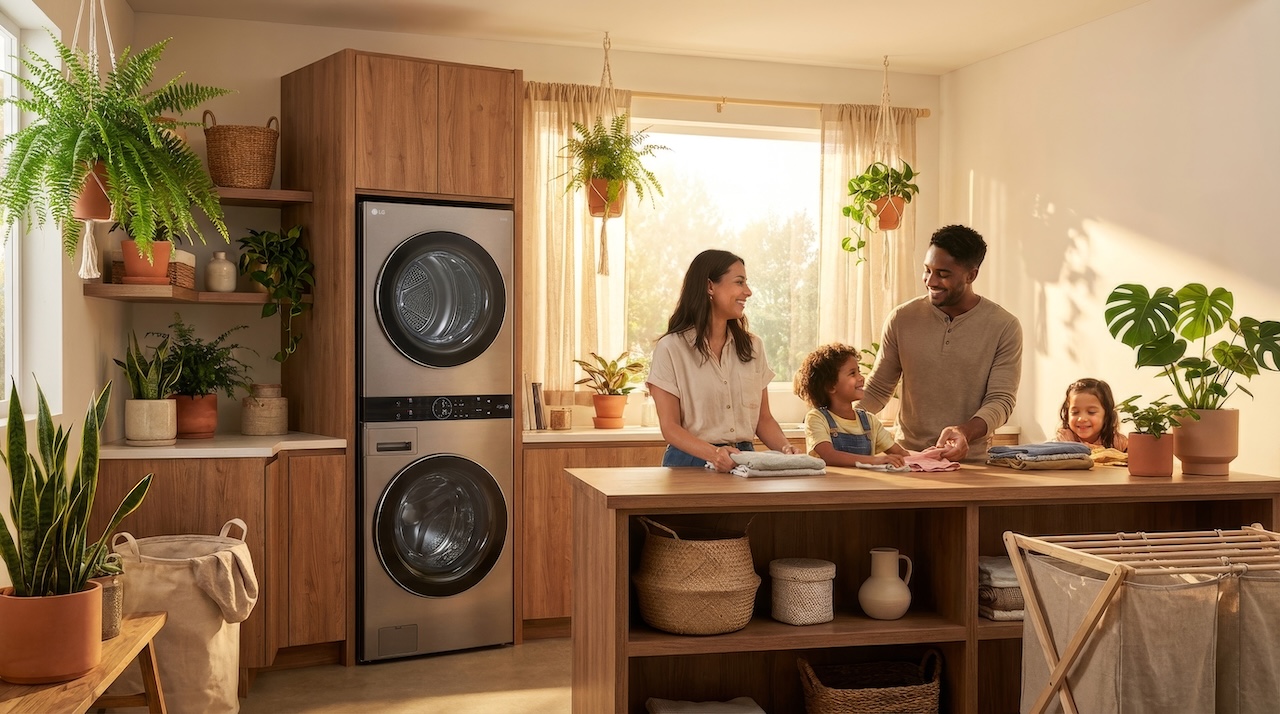
The LG WashTower, for example, combines a washer and dryer in a single vertical system. Instead of placing the two machines side by side and using additional floor space, the dryer sits above the washer as part of one integrated unit.
For an apartment resident, the benefit is fairly simple: two laundry functions without needing two separate areas on the floor.
For developers, the same approach can offer greater flexibility when planning compact utility spaces.
Making small spaces work harder
Space, however, is only one part of the equation.
Nairobi’s weather can also make drying clothes outdoors unpredictable. Dust, rain and the demands of apartment living can make indoor drying more practical for some households.
Having washing and drying in one system means clothes can move through the process without having to be transferred between separate machines or taken outside to dry.
The WashTower also brings intelligent features into the process.
Its AI DD™ technology analyses the weight of a load and the characteristics of different fabrics before selecting appropriate washing motions. Rather than treating every load in exactly the same way, the system can adjust its operation according to what is inside the drum.
That can be useful for households dealing with everything from everyday office clothes to children’s uniforms, towels and more delicate garments.
Small design details can make a difference
The physical layout of an appliance also matters when space is limited.
The WashTower uses Centre Control™, placing the controls for the washer and dryer between the two units.
With conventional stacked machines, the controls for the upper appliance can be difficult to reach, particularly for shorter users. Bringing both sets of controls into one central location makes the system easier to operate.
It is a relatively small design decision, but these are often the details that determine whether an appliance works well in everyday life.
Saving time is part of the appeal
Urban households are also becoming increasingly time-conscious.
Long working hours, commuting, school schedules and family responsibilities leave little room for household chores. Appliances that can reduce the time spent managing routine tasks therefore have an obvious appeal.
LG’s TurboWash™ 360 technology uses multiple water jets to clean clothes efficiently, with selected cycles taking as little as 39 minutes.
The WashTower also features Smart Pairing™, allowing the washer to communicate with the dryer and recommend a suitable drying programme for the load.
The aim is to reduce some of the decisions that traditionally sit with the user.
Instead of finishing one stage of the process and then deciding what to do next, the system can use information from the wash to guide the drying cycle.
The energy question
Operating costs are another consideration for households.
A modern appliance has to do more than perform well when it is switched on. Energy consumption matters over months and years, particularly as households become more conscious of their utility bills.
The WashTower’s Dual Inverter Heat Pump dryer recirculates heated air during the drying process and operates at lower temperatures than conventional high-heat drying systems.
That approach can reduce energy consumption while being gentler on fabrics.
The vent-free heat pump design is also useful in apartment settings because it does not require an external dryer vent. That gives homeowners and developers greater flexibility when deciding where a laundry system can be installed.
A connected home needs connected appliances
Then there is the smartphone.
Through the LG ThinQ™ app, users can monitor laundry cycles remotely, receive notifications when a cycle is complete and access diagnostic information.
For someone leaving home for work in the morning, that can mean checking the status of a load without having to physically return to the laundry area.
It is part of a wider shift towards connected homes, where everyday appliances are increasingly expected to communicate with their owners rather than simply wait for instructions.
What this means for Kenya’s apartment market
The growth of integrated appliances also has implications beyond individual homeowners.
As Nairobi’s residential market becomes more competitive, developers are looking for ways to make apartments more practical and attractive. Features that improve everyday living can become selling points, particularly in smaller units where space is at a premium.
Kitchens have already evolved in this way. Fitted cabinets, built-in ovens and integrated storage are now familiar features in many modern developments.
Laundry spaces could be heading in a similar direction.
An appliance that combines washing and drying while taking up relatively little floor space gives developers another way to make compact homes feel more functional.
The future may be about doing more with less
Kenya’s urban homes are unlikely to suddenly become much larger. In many cases, the opposite may happen as developers continue to respond to land prices, population growth and demand for housing in well-connected areas.
The answer, then, may be to make better use of the space that already exists.
That is where integrated appliances make sense.
The appeal of products such as the LG WashTower is less about fitting another gadget into the home and more about combining several household needs into a single system.
As urban living continues to evolve, appliances will increasingly be judged by how well they fit into real homes, how much space they require, how much energy they use and how much effort they save.
For Kenya’s growing apartment market, that could make integrated laundry systems an increasingly familiar part of modern home design.
To learn more about the LG WashTower and its features, visit LG East Africa.
Follow us on X, Instagram and Facebook for the latest stories, trends and updates from Nairobi and beyond.