Beyond Downtime, Government Must Keep Citizens Informed

Public digital services carry a weight that most commercial platforms do not. When a government portal goes down, a traveller may miss a flight, a clearing agent may be stuck with goods at the port, and a taxpayer may run past a filing deadline. That raises the standard for how institutions talk to the public when something breaks. Silence creates queues and rumours, and technical jargon tells citizens very little. A responsible notice explains what is affected, what still works and what the user should do next.
Name the service that failed
A line such as “the system is down” is rarely precise enough. A single platform can contain application, payment, verification, notification and back-office components, and one can fail while the others keep running. A good notice names the affected service and functions, gives the time the incident began and states the geographic or user scope where it is known. It should also hold back from announcing full recovery until the complete citizen journey has been tested from start to finish.
The distinction matters in practice. If applications can still be created but payments cannot be confirmed, users need to know that, because it changes what they should do.
Protect people from paying twice
Payment interruptions call for specific instructions. A user who sees no confirmation may well try again and be charged a second time. The notice should say whether pending transactions will be reconciled automatically, whether users should wait before retrying and how to report a duplicate. The original reference should stay valid so support teams can trace the event across the portal, the payment channel and the bank.
Behind this sits a design choice. A well-built government payment flow keeps authorisation, settlement and public accounting separate, which makes it possible to resolve a payment even when the screen failed after the bank approved it.
Offer another way through
Critical services need continuity arrangements. The alternative might be a different channel, an assisted service point, a temporary deadline extension or a documented manual process. Whatever form it takes, it must not weaken legal or security controls. It should be approved in advance, logged and reconciled once the main system returns.
The plan also has to include people with disabilities, limited connectivity or urgent circumstances. An alternative that exists only in the capital is not a national continuity measure.
Promise the next update
An early notice may not have a recovery estimate, but it can still commit to a time for the next update. Regular updates cut down on repeated calls and let businesses make decisions. If the estimate shifts, the notice should say so, and older updates should stay visible with timestamps rather than being overwritten.
Keep authority and operator distinct
The public institution stays responsible for the service and its legal consequences. A technology provider may investigate infrastructure or application faults, a bank resolves payment problems and a telecom operator handles connectivity. The notice should point citizens to the right place for help without turning into a debate about blame. Root-cause analysis can follow once the service is stable.
Crawford Capital’s operating-status collection shows the value of dating administrative and service changes. For any provider, though, the authoritative current-status notice should come from the public institution responsible for the service.
Report what changed afterwards
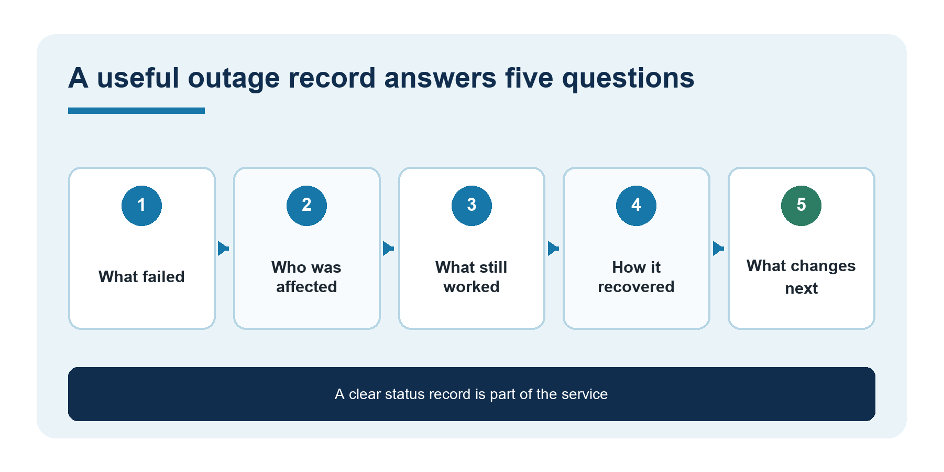
After recovery, a post-incident report should cover the impact, duration, technical cause at a suitable level of detail, recovery actions and preventive work. It should account for affected transactions, unresolved cases and the date of the next review. It does not need to expose exploitable security detail, but it should be specific enough for an auditor to check whether the stated fix was completed.
Useful measures include uptime, failed transactions, time to detection, time to recovery, complaints, duplicate payments and recovery-test results. The World Bank’s GovTech Maturity Index treats online service delivery and the systems behind it as separate parts of public-sector digital maturity.
A clear public notice can fit into six lines:
- Service and functions affected.
- Start time and known scope.
- What users should avoid doing.
- Available alternative route.
- Where payment or application references can be checked.
- Time of the next update.
Once the service is back, add the recovery time and a link to the fuller incident report.
Reliability does not mean the absence of failure. It means detecting problems, protecting users, keeping essential services available and explaining what happened. A government platform earns trust through a fast everyday journey, and it earns more of it through calm, accountable behaviour when that journey breaks.