Absa Bank’s KES 204 Billion Green Finance Milestone
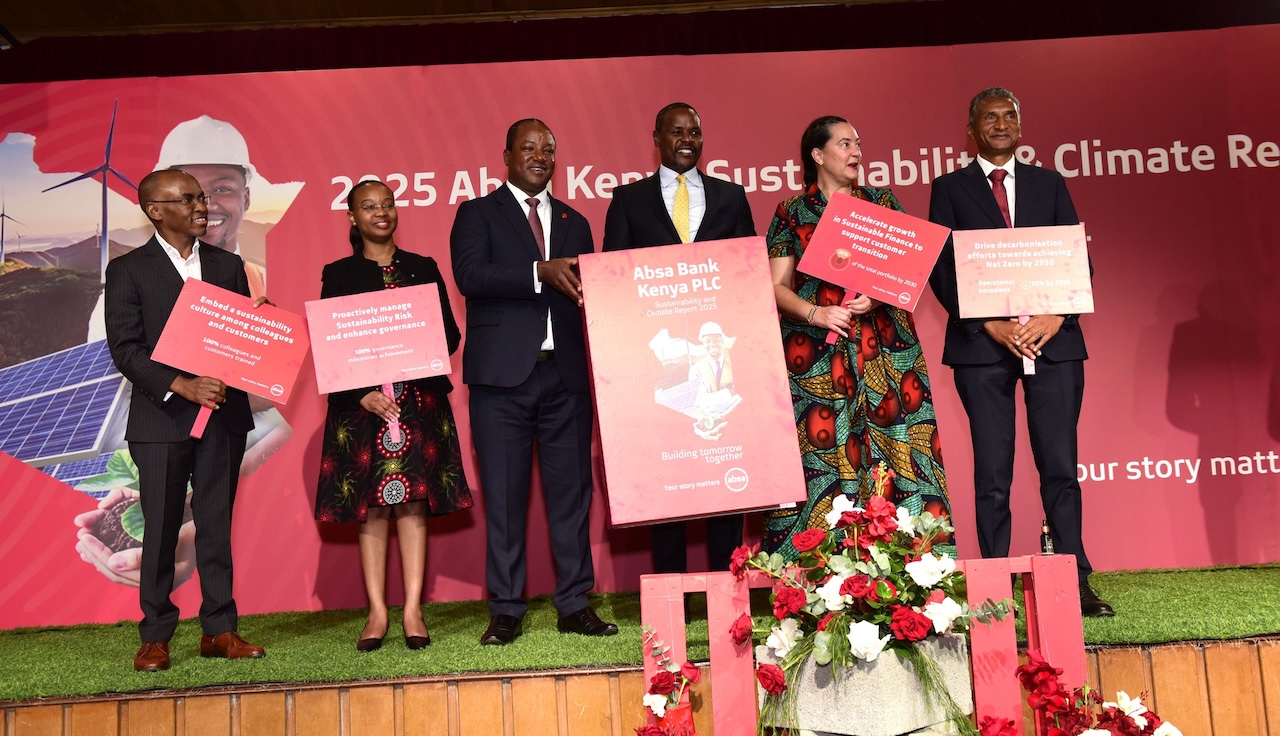
Absa Bank Kenya Tops KES 204 Billion in Sustainable Finance Since 2022
Sustainable finance is becoming one of the biggest forces shaping Kenya’s economy, with banks directing more capital towards projects that deliver both financial returns and positive environmental and social outcomes.
Absa Bank Kenya is among the institutions leading that shift. The lender has disbursed more than KES 204 billion in sustainable finance between 2022 and 2025, supporting renewable energy, climate-smart agriculture, green buildings, financial inclusion and enterprise growth. The figures are contained in the bank’s 2025 Sustainability and Climate Report, launched in Nairobi this week.
In 2025 alone, Absa advanced KES 55.3 billion in sustainable finance, up from KES 47 billion in 2024.
Of that amount, KES 48.8 billion supported financial inclusion through lending to SMEs, women-led businesses, young entrepreneurs and underserved communities. Another KES 6.5 billion went towards climate finance, funding renewable energy projects, energy-efficient developments, green buildings and climate-smart agriculture.
Sustainable lending surpasses targets
The report shows sustainable finance accounted for 30% of Absa’s gross loan disbursements in 2025, significantly outperforming the bank’s original annual target of 10%.
Speaking during the report launch at Strathmore University, Interim Managing Director and CEO Yusuf Omari said the bank has intentionally invested in sectors capable of creating lasting economic, social and environmental value.
“Our 2025 Sustainability and Climate Report highlights what we have achieved under our 2021–2025 sustainability strategy. From supporting businesses to grow and enabling access to affordable housing, to financing climate-smart agriculture, renewable energy and broader financial inclusion, we have intentionally deployed capital where it can make the greatest difference.”
He added that Absa remains committed to partnering with businesses, government and communities to support Kenya’s long-term development.

Investing beyond finance
Alongside its lending activities, the bank reported significant progress in reducing its own environmental footprint.
During 2025, Absa planted 283,969 trees, almost four times the number planted the previous year, bringing its cumulative total to more than 1.5 million trees.
The bank also achieved a 96.4% waste recycling rate and reduced its operational energy consumption by 41%, reflecting its long-term commitment to achieving net-zero emissions.
Expanding opportunities for young people
The report also highlights continued investment in youth development through the ReadytoWork programme.
Nearly 38,000 young people received employability and entrepreneurship training during 2025, increasing the programme’s total beneficiaries to more than 300,000.
Meanwhile, the Absa Kenya Foundation reached over 50,000 people through programmes focused on education, entrepreneurship and natural resource management.
Stronger climate governance
Absa also strengthened the integration of climate considerations into its lending decisions, business strategy and enterprise risk management.
The bank enhanced its sustainability reporting by aligning with the International Sustainability Standards Board (ISSB) framework, including IFRS S1 and IFRS S2, strengthening transparency around climate-related risks and opportunities.
Looking ahead
Building on the progress made under its 2021–2025 Sustainability Strategy, Absa has introduced a new sustainability roadmap centred on four priorities:
- Increase sustainable finance so that at least 30% of gross loan disbursements support financial inclusion, green finance and nature-based finance.
- Achieve net-zero emissions by 2050 through a long-term decarbonisation strategy.
- Strengthen sustainability governance and climate risk management.
- Embed sustainability into the bank’s culture while improving customer experience.
As Kenya accelerates investment in clean energy, climate resilience and inclusive growth, financial institutions are expected to play an increasingly important role in funding projects that generate long-term economic and environmental value.
Follow us on Twitter and Facebook for more updates.