KCB Foundation Launches Tujenge Pamoja Initiative
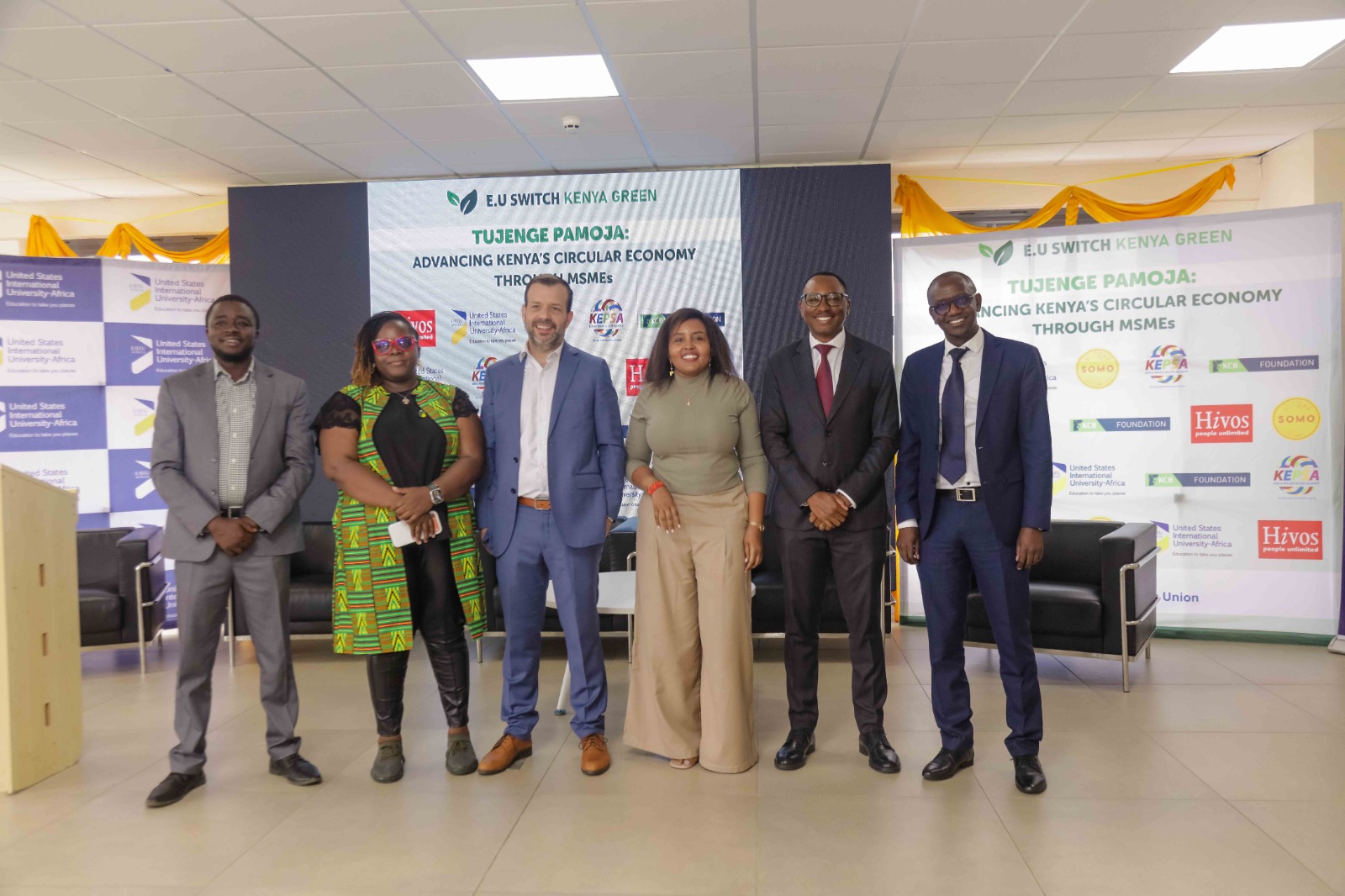
KCB Foundation, Partners Launch ‘Tujenge Pamoja’ Initiative to Drive Kenya’s Circular Economy Transition
KCB Foundation has partnered with Hivos, the Kenya Private Sector Alliance (KEPSA), Somo and United States International University-Africa to launch the European Union-funded “Tujenge Pamoja” initiative aimed at accelerating Kenya’s transition to a circular green economy.
Implemented under the EU SWITCH Africa Green Programme, the initiative seeks to shift Kenya away from the traditional linear “take-make-dispose” economic model toward a circular economy built on repair, reuse, recycling and resource efficiency.
The programme will support 3,200 Micro, Small, and Medium Enterprises (MSMEs) to adopt sustainable and commercially viable circular business models. In addition, it will strengthen 40 Business Support Organizations (BSOs) and Technical and Vocational Education and Training (TVET) institutions to serve as innovation and enterprise development hubs across the country.
Speaking during the launch in Nairobi, KCB Foundation Director Mendi Njonjo said the programme is designed to strengthen livelihoods while supporting sustainable economic growth.
“This programme is about economic resilience, dignity, and opportunity for millions of Kenyans whose livelihoods depend on MSMEs. By empowering small businesses with green financing, innovation and skills, we are building enterprises that can compete, create jobs and drive Kenya’s transition to a more inclusive and circular economy,” said Njonjo.
The initiative also aims to create green jobs, particularly for women and youth, while reducing waste streams and greenhouse gas emissions. It will further improve access to green financing through catalytic funding mechanisms intended to help enterprises scale environmentally responsible solutions.
European Union Ambassador to Kenya Henriette Geiger noted that the transition to a circular economy presents both environmental and economic opportunities for the country.
“The transition to a circular economy is not only an environmental imperative but also a major economic opportunity for Kenya. Through ‘Tujenge Pamoja’, we are strengthening innovation, supporting MSMEs, creating green jobs and promoting inclusive growth that leaves no one behind,” she said.
With a strong focus on Gender Equality and Social Inclusion (GESI), the “Tujenge Pamoja” initiative prioritizes women-led, youth-led and marginalized enterprises to ensure an inclusive transition to sustainability.
The programme will promote innovative solutions across key value chains, including plastics and packaging, organic waste management through composting and biogas solutions, as well as sustainable textiles.
The initiative aligns with Kenya Vision 2030, the country’s Nationally Determined Contributions (NDCs) under the Paris Agreement and the United Nations Sustainable Development Goals (SDGs), particularly SDG 8 on Decent Work and Economic Growth, SDG 12 on Responsible Consumption and Production and SDG 13 on Climate Action.