Kenya Beyond Sight: Four Days of Inclusive Travel Across Coastal Kenya
Kenya Beyond Sight: Four Days That Turned Travel Into Something You Could Feel
The itinerary said Eastern and Coastal Kenya. What it did not say was that by the end of it, six people would have touched a giraffe’s tongue, learned to read a shell with their fingers and turned a birthday cake at Temple Point into the opening line of a much bigger story.
Kenya Beyond Sight was never built to be watched from a distance. It was built to be lived and for four days, that is exactly what happened.
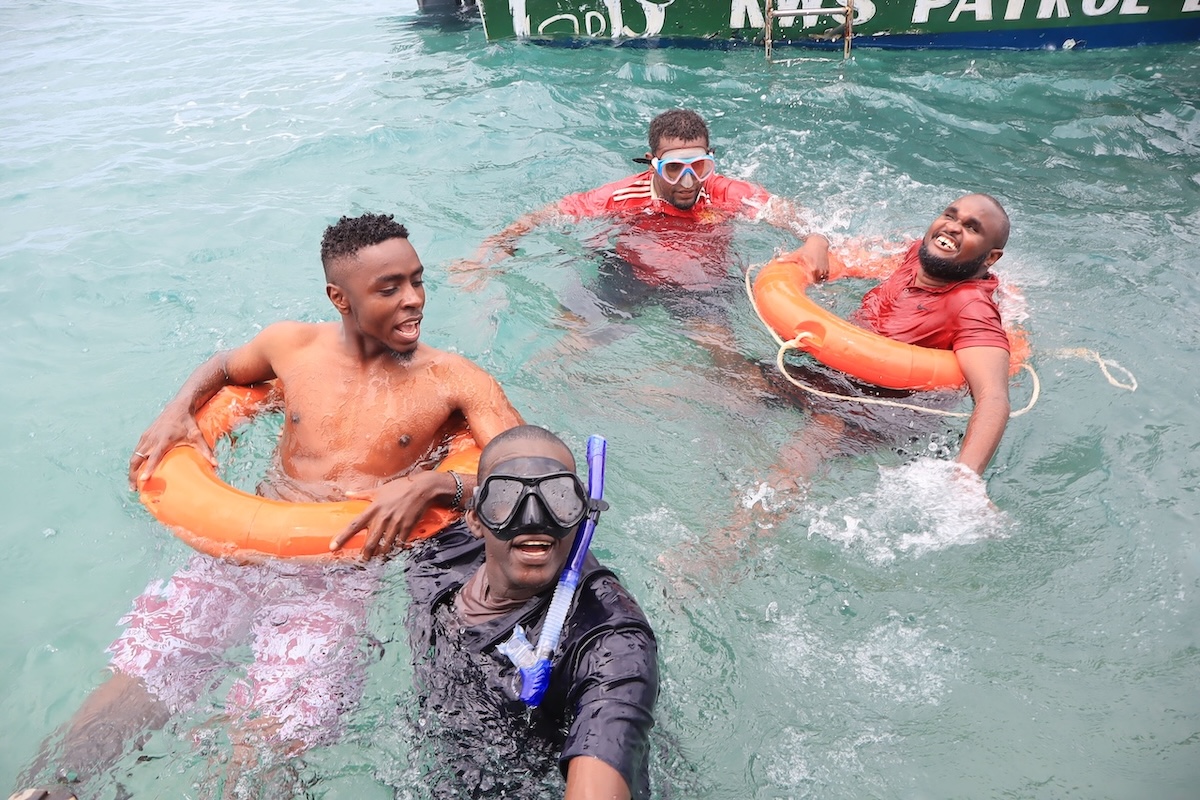
The journey found its rhythm at Malindi Marine National Park, where the day opened with cake and closed with song. Jsupercharge, the campaign’s Vision Bearer, marked his birthday at Temple Point before the group gathered for a briefing from Ntindi Kassim, Senior Warden at KWS Malindi. Then came the water.

Guided by boat crew from the local community, the creators went snorkelling, every one of them, including those living with visual impairment, albinism and physical disabilities. There was no adjusted version of the experience. There was one experience, and everyone was in it.
Lunch followed on an island in the middle of the Indian Ocean, seafood shared under open sky and the day ended the way good days at the coast tend to end, with music and dancing that nobody wanted to cut short. Kenya Wildlife Service’s policy of free entry for persons with disabilities made the day possible in the first place, a quiet but significant detail in a country still learning what accessible tourism looks like in practice.
A Card, A Craft, A Conversation
Day Three began gently, creators trading ideas and easy laughter before the road pulled them toward Watamu. At RUBiS Watamu, the group stopped at Carrefour, where the KCB Prepaid Carrefour Card left the pitch deck and entered real life. No stage, no scripted demonstration, just a group of travellers paying for what they needed the way anyone would. Sometimes a product tells its own story best when nobody is trying to tell it.
From there, the road carried them into Mombasa and toward Bombolulu Cultural Centre and this is where the day changed shape entirely.
Bombolulu is home to the Association for the Physically Disabled of Kenya, a place where skill and craft have become tools of economic independence. The creators sat with artisans, listened to their stories and ran their hands over jewellery, leatherwork and woodwork built by people who have turned circumstance into livelihood. Nobody there needed sight to appreciate the work. They needed patience, curiosity and a willingness to feel their way through a story instead of glancing past it.
By evening, the team understood something the itinerary could never have written for them: travel is not only about new places. Sometimes it is about who you meet inside them.
When the Wild Comes Close Enough to Touch
If Day Three was about people, Day Four was about presence.
At Haller Park in Bamburi, a former limestone quarry turned conservation success story, the group met tortoises first, tracing the ridges of their shells and feeling the slow, deliberate weight of their movement. Then came the snakes, handled under the steady guidance of Celine Mukonzo, met with equal parts nerve and fascination.
But it was the giraffes that stayed with everyone. Holding out food and waiting for that long, searching tongue to wrap around it and pull away is an encounter most people experience through sight alone. For this group, it became something closer, felt in the anticipation of the crowd, heard in the shifting weight of hooves, sensed in the charged half second before contact. Nobody needed to see the giraffe to know exactly how close it had come.
The day ended on Mombasa’s streets, unscripted and unstaged, just conversation with strangers and the ordinary pulse of a city going about its evening.
Why This Journey Matters
What makes Kenya Beyond Sight different is not the itinerary. Kenya has no shortage of marine parks, cultural centres and wildlife sanctuaries. What is different is the insistence that these places belong to everyone, not as an accommodation made after the fact, but as the starting point of the design.
KCB Group Director for Marketing and Communication, Rosalind Gichuru, called it a practical expression of the bank’s purpose, “For People. For Better,” while backing it with something tangible: cashless payments through Debit and Prepaid Cards that let the creators move through accommodation, transport, dining and attractions without friction. KTB CEO June Chepkemei went further, framing the trip as a challenge to the entire tourism value chain to ask a harder question: how do you make a destination easier for every visitor to explore, participate in and feel welcome inside.
Kenya’s tourism sector contributed $12.7 billion to the economy in 2025, according to the World Travel and Tourism Council, supporting 1.8 million jobs. Growth on that scale means little if the experiences behind it remain closed to a portion of the people trying to access them.
By the fourth day, the six creators had snorkelled beside marine wardens, shopped in Watamu, held Bombolulu’s handiwork in their palms and fed giraffes with their bare hands. None of it needed sight to matter. It needed only the chance to happen.
That, in the end, is the whole point of Kenya Beyond Sight. Kenya is more than what you see. It is what you experience.
Follow us on Twitter, Facebook and Instagram for more updates.