Kenya’s 5% Disability Employment Rule
Why Kenya’s 5% Disability Employment Rule Is Forcing Companies to Rethink Hiring
The Persons with Disabilities Act 2025 is already shifting how companies in Kenya hire, measure teams and design workplaces. You can see that shift in real numbers. Safaricom sits at 4% representation of employees with disabilities, one point below the legal target. That gap tells a bigger story about where corporate Kenya stands today.
This is no longer a side conversation for HR teams. It is now a legal requirement backed by policy, tax incentives and growing public scrutiny.
What the law now requires
The Persons with Disabilities Act, 2025 (No. 4 of 2025) sets a clear direction. It defines disability broadly, covering physical, sensory, mental, intellectual, and developmental conditions, including albinism. The law focuses on participation in everyday life, including work.
It also sets a measurable target. At least 5% of employees in public and private organisations should be persons with disabilities.
The law adds financial signals. Companies that modify offices for accessibility can claim tax deductions. Imports of assistive materials receive tax exemptions. These provisions reduce the cost of inclusion, which has often been used as a reason for slow progress.
Where companies actually stand
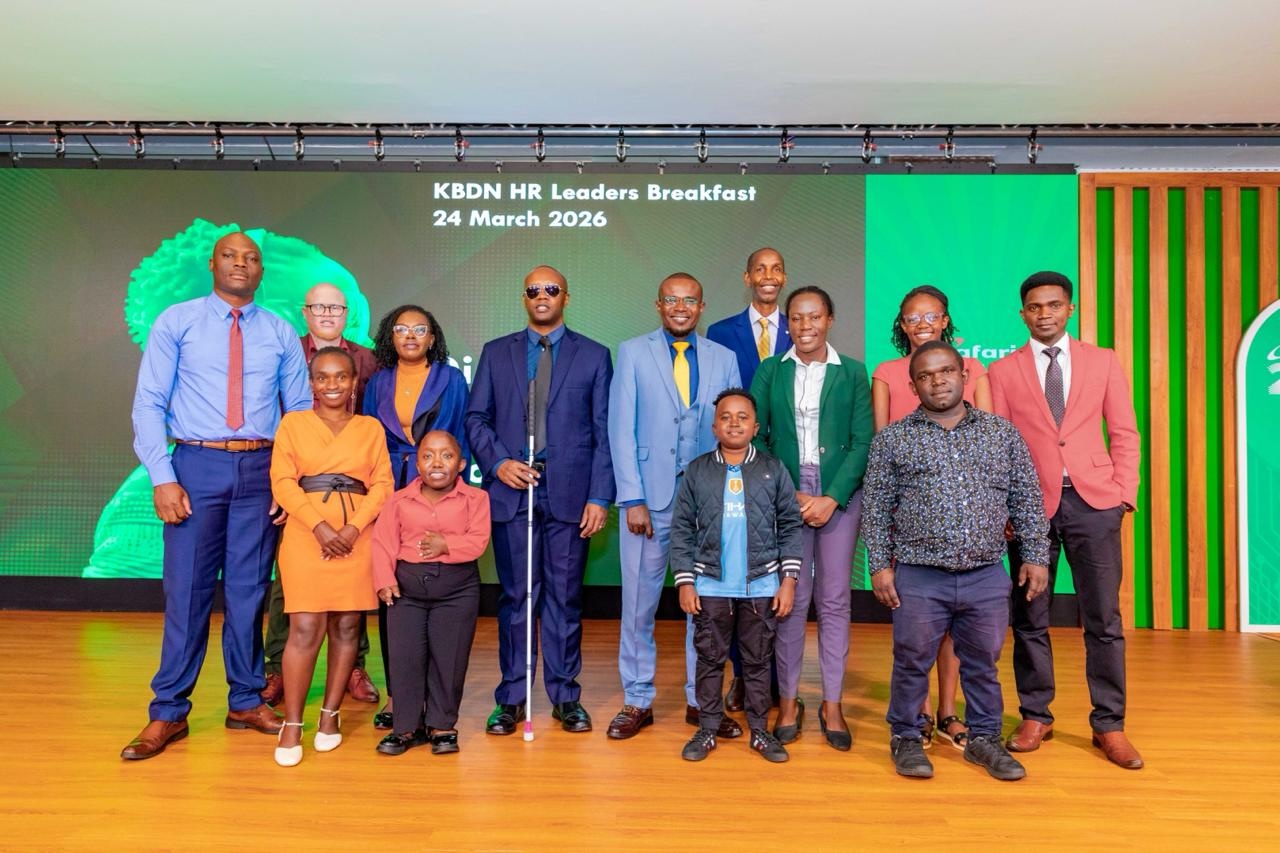
Data shared during the KBDN HR Leaders Breakfast gives a rare look inside one of Kenya’s biggest employers.
Safaricom’s internal report shows steady growth over time:
- 1.7% (99 employees) in 2018
- 2.4% (133 employees) in 2020
- 4% (228 employees) in 2026
That growth matters. It shows deliberate hiring and internal changes. It also shows how slow the climb can be.
The company is now one percentage point away from the legal threshold. Closing that gap will likely require targeted recruitment, workplace adjustments and retention strategies.
Why businesses are paying attention
There is a business case, and companies are quoting it openly.
One slide in the report carries a quote from Sundar Pichai:
“Diverse teams are more innovative, they understand our customers better and they make better decisions.”
The same presentation links diversity to outcomes:
- 87% of diverse teams make better decisions
- Organisations with strong diversity and inclusion see 50% lower turnover
- Companies prioritising diversity attract talent at twice the rate
These numbers explain why disability inclusion is moving from compliance to strategy. Companies want better teams, not just legal cover.
Inclusion goes beyond hiring
Hiring alone does not fix the problem. The report breaks diversity into several layers.
It includes demographic factors such as disability, gender and age. It also includes experiential and cognitive diversity, like education, problem-solving styles and neurodiversity.
That framing matters. It pushes companies to rethink how teams work, not only who gets hired.
Another line from the report captures this clearly:
“Diversity is a fact. Inclusion is a choice. Belonging is an outcome.”
You can hire for diversity. You still need systems, culture and leadership to make people stay and perform.
The pressure is now public
The 5% requirement creates a simple benchmark. Companies can no longer hide behind vague commitments. You either meet the number or you don’t.
For large firms like Safaricom, sitting at 4% places them in a visible position. Close, but not compliant.
For smaller firms, the challenge is different. Many are starting from near zero. The law forces them to build hiring pipelines, rethink job design and invest in accessibility.
What this means for you
If you run a business or manage teams, this law affects your hiring decisions now.
You need to look at your workforce numbers and ask a direct question. How far are you from 5%?
If the gap is wide, you will need partnerships with disability organisations, accessible hiring processes and internal training. If you are close, retention becomes the bigger issue.
The shift is already happening. The numbers from Safaricom show progress, but they also show how much work remains.
Kenya has moved from policy talk to measurable targets. The next phase will be accountability.